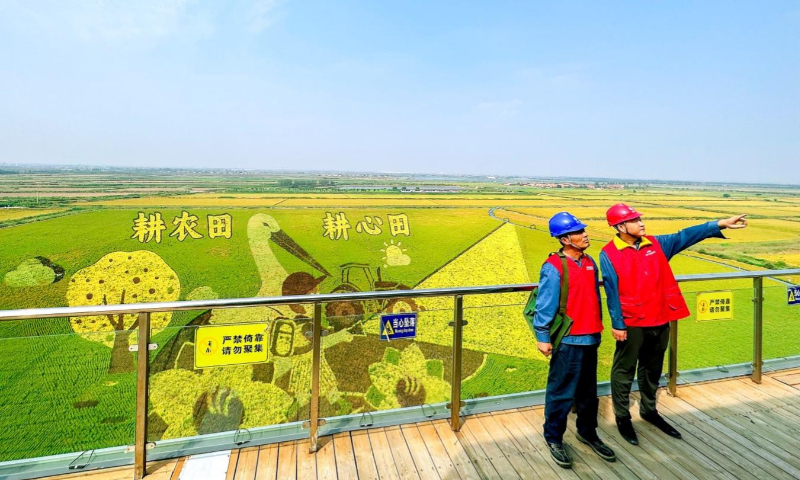
On September 20th, walking into the rice field painting scenic area of Yong'an Town, in the Kenli District of Dongying City, Shandong Province, the theme of "rural revitalization, agricultural power" and "cultivation of the farmland" came into view. The paddy fields, paths and the colorful rice intertwine and complement each other, creating a scene of good harvest.
The paddy painting landscape creative base reportedly covers an area of 13,000 acres and promotes the integrated development of agriculture and tourism by combining creative agriculture and leisure tourism. At present, during the best viewing period of rice field paintings, the staff of the State Grid Dongying Power Supply Company has strengthened the publicity of safe electricity use in scenic areas, inspected the operation of equipment such as power distribution lines and observation tower lighting facilities in scenic spots, and ensured the safe and reliable electricity consumption for tourists during peak viewing periods. Kenli District of Dongying City is located at the estuary of the Yellow River. In recent years, the region has relied on its rich saline-alkali land resources, developing characteristic industries according to local conditions, and has gone all out to build a "Rice and Crab Symbiotic Planting" within the rural revitalization demonstration area. The State Grid Dongying Power supply company, regularly docks with the governmental development planning and electricity demand according to seasonal planting, periodically provides on-site guidance for enterprises on rice seedlings optimization, processing and electricity consumption plans, and coordinates the construction of supporting power facilities such as line transformation and well electrification to help industrial development. Each year, during the rice field painting exhibition, a tailor-made "one household, one policy" power supply service plan is provided for important customers, with regular inspection of lines and equipment, prompt elimination of safety hazards in electricity facilities, fully meeting the needs of the development of agricultural and industrial tourism integration, and injecting strong momentum for a rural revitalization supplied with sufficient electricity.
Throughout this year, several high-ranking Chinese officials have led delegations to visit Egypt, reaching a high degree of consensus on strengthening bilateral cultural exchange and promoting tourism cooperation. They have put forward several practical measures to deepen exchange and cooperation between the two countries. As exchanges between the two countries deepen, an increasing number of Chinese tourists are choosing to travel to Egypt - this has kept Abbas Sayed Abbas, a Chinese-speaking Egyptian tourist guide, extremely busy.
Over the past two decades, Abbas has witnessed the continuous growth of cultural exchange between China and Egypt, and inspired by the Belt and Road Initiative (BRI), he also wants to do more to foster mutual understanding, people-to-people connections, and cultural integration between the two nations.
'Chinese culture fever'
"I had excellent grades in high school and could choose any university and study any language, but I told my older brother that I wanted to learn Chinese. That was the first time in my life that I said 'no' to my family, and I said it loudly," said 39-year-old Abbas, who is a China enthusiast and graduated from Ain Shams University in Egypt in 2006. Initially, when he chose to study Chinese, his family did not have high hopes.
After graduating from high school, Abbas and his brother, who was studying Russian, went together to check their exam results. On the way there, Abbas told his brother that he wanted to learn Chinese and work as a tourist guide for Chinese visitors. Abbas recalled that at that moment, his brother gave him a skeptical glance and said, "Chinese is too difficult. Don't learn Chinese; you should study Russian like me."
At that time in 2002, there were few Chinese tourists traveling to Egypt, and opportunities for translation work were also fleeting.
Abbas told the Global Times that when he decided to learn Chinese, he didn't think too much about it and didn't aim to make a lot of money. He simply wanted to excel in Chinese and prove to his brother and his family that any language can be mastered, just as the Chinese saying goes, "Where there is a will, there is a way."
In 2022, Egypt launched a pilot project for Chinese language education in secondary schools, marking the official inclusion of Chinese teaching in Egypt's national education system. Abbas said that Egypt now has 12 public secondary schools offering Chinese education and nearly 30 universities offering Chinese subjects. They have also established four Confucius Institutes, two Confucius Classrooms, and two Luban Workshops. The "Chinese language craze" and "Chinese culture craze" in Egypt are on the rise.
As cultural exchanges between China and Egypt have deepened, Abbas increasingly feels that he made the right choice all those years ago. Starting from his sophomore year, he worked as a local Chinese tourist guide, welcoming Chinese tourists.
Even though there weren't as many Chinese tourists back then, during the Chinese New Year, Chinese tour groups would visit Egypt, Abbas said, and he would seize the opportunity to work as their guide and translator to make some extra money.
'Happiest person in the world'
In 2010, Abbas applied and was hired as the assistant director of the China Cultural Center in Cairo. While introducing Chinese culture to the Egyptian people, he also received esteemed guests from China, such as serving as a translator for Chinese director Zhang Yimou in 2012.
Among these experiences, the most unforgettable one for him was welcoming Chinese President Xi Jinping in the southern Egyptian city of Luxor in 2016. Abbas told reporters that he in Egypt felt the energy of "Chinese Dream" put forward by President Xi - the dream to help ordinary people achieve their own dreams. Abbas had only seen President Xi on television before and was very eager to meet him in person. At the Karnak Temple entrance, President Xi invited Abbas for taking a photo with him and shook hands with Abbas, making Abbas felt like the "happiest person in the world."
Abbas mentioned that following the pandemic, Chinese tourists have started to return, gradually reviving local tourism economy.
BRI brings new vitality
In addition to tourism and cultural exchanges, China and Egypt have cemented partnerships across a number of fields, including industry, energy, telecommunications, and infrastructure construction. The BRI is deeply aligned with Egypt Vision 2030. In addition to projects like the Central Business District in the new administrative capital, major projects like the New Alamein City and Egypt's first electrified light rail transit system are progressing on schedule.
In Abbas' view, the BRI is about "connecting" countries. China first successfully "connected" itself and then extended these modern, advanced connections to the world. Abbas said the BRI not only revives the Silk Road but also connects the civilizations of the world, which serve as the greatest achievement of the BRI.
The BRI has brought many benefits to Egypt and has made a significant contribution to the world. In the long run, the great significance of this initiative lies in its embodiment of the precious value of building a community with a shared future for mankind, Abbas told the Global Times.
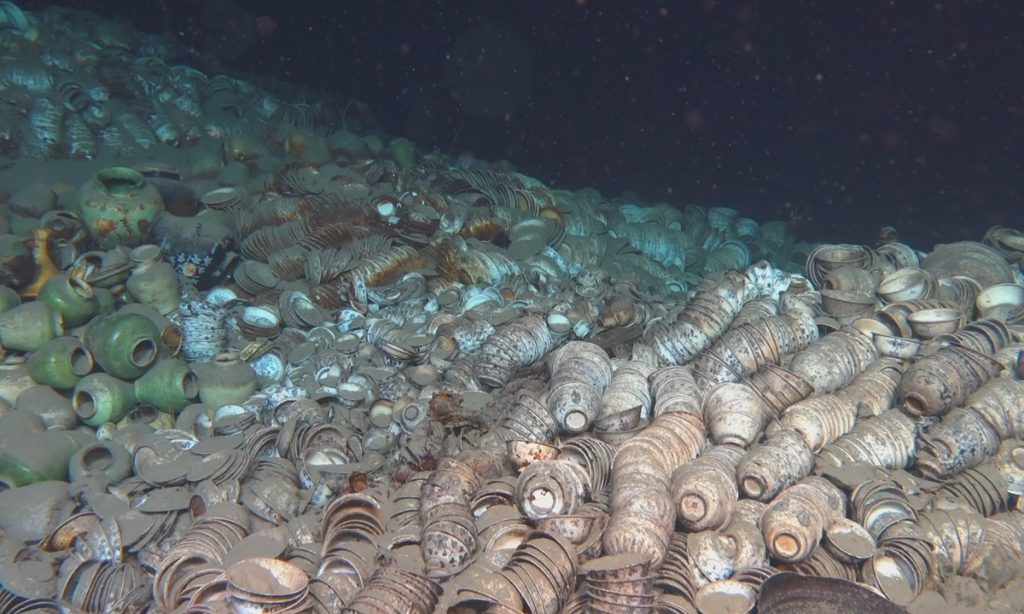
China's manned submersible Shenhai Yongshi (Deep-sea Warrior) placed underwater permanent survey markers at the core areas of two Ming Dynasty-era sunken ships in the South China Sea after conducting preliminary search and image recordings on Saturday, opening a new chapter in China's deep-sea archaeology.
An underwater archaeological investigation formally kicked off on Saturday for the two ships discovered last October in the South China Sea, said China's National Cultural Heritage Administration on Sunday.
The two ships were discovered in October 2022 in the South China Sea at a depth of about 1,500 meters. One site is mainly composed of about 100,000 porcelain relics. Based on a preliminary survey, the ship may have sunk during the Emperor Zhengde period (1506-21) of the Ming Dynasty.
The other site has a large number of timber logs, and the ship is believed to have been carrying overseas cargoes to China, dating back to the Emperor Hongzhi period (1488-1505) of the Ming Dynasty.
Archaeologists said the systematic archaeological investigation will last for about a year in three phases.
The first phase began on Saturday and will last until early June. Manned submersibles will be released to determine the distribution range of the sites for multi-angle and comprehensive data collection and archaeological recording, and to extract specimens of representative cultural relics and samples of the seabed sediment.
The second and third phases are planned to be implemented from August to September in 2023 and from March to April in 2024. After the archaeological surveys, the next step will be proposed on the basis of the sunken ships' status and technical conditions.
The investigation of the two shipwrecks will provide evidence of ancient Chinese people's activity in the South China Sea, making breakthroughs in the study of Chinese maritime history, ceramic history, overseas trade history and the Maritime Silk Road.
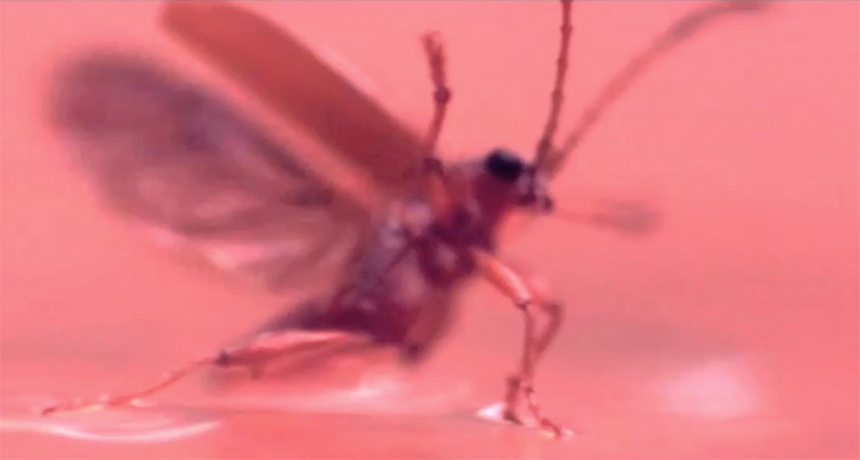
Waterlily beetles (Galerucella nymphaeae) literally fly across water, high speed videography and a bit of mathematical modeling reveals.
The beetles have a combination of hydrophobic hairs that line their legs and hydrophilic claws that grip the surface of water without getting too wet. Prior to “take off,” the insects lift their middle pair of legs. Then, the insects beat their wings extremely fast and fly horizontally across a pool of water. It looks a lot like water-skiing. In lab tests, waterlily beetles reached 0.5 meters per second — without an active brake system. Surface tension keeps the insects afloat, they found. The insects create ripples in the water, which generates drag at speeds greater than 0.23 meters per second (more drag than when the beetles just fly through air). Thus, for these beetles, skiing across a pond at breakneck speeds costs a lot of energy and requires greater wing thrust than normal flying. However, this mode of getting around could be more advantageous for foraging and help them avoid underwater predators like fish, the researchers speculate March 2 in the Journal of Experimental Biology.
Ancient Assyrians sent their dead to the afterlife with fearsome companions: turtles. Excavations of a burial pit in southeastern Turkey revealed skeletons of a woman and a child, plus 21 turtles, a team led by archaeologist Rémi Berthon of France’s National Museum of Natural History reports in the February Antiquity.
The burial is part of an Assyrian site called Kavuşan Höyük that dates to between 700 and 300 B.C. The turtle bonanza included shells from one spur-thighed tortoise (Testudo graeca) and three Middle Eastern terrapins (Mauremys caspica), plus bones from 17 Euphrates soft-shelled turtles (Rafetus euphraticus). Butchering marks on the R. euphraticus bones indicate that the turtles may have been eaten in a funerary feast, Berthon and his colleagues write. Back then, turtles were not a regular meal in Mesopotamia. Turtle bones, however, were thought to ward off evil. The abundance of R. euphraticus turtles, a notoriously aggressive species, in this burial pit suggests the deceased had high social status.
To ancient Assyrians, these ferocious reptiles probably represented eternal life and served as psychopomps — mythical guides to the afterlife, the team writes.
Editor’s Note: This story was updated on 4/15/16 to note that turtles were a rare part of the Mesopotamian diet.
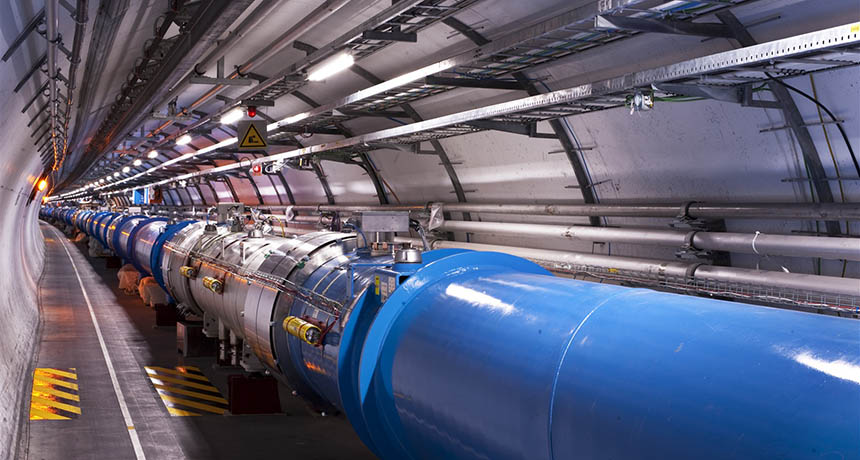
CERN’s Large Hadron Collider is in standby mode after a 66-kilovolt/18-kilovolt electrical transformer suffered a short circuit April 29 at 5:30 a.m. Central European Time. The culprit: A small wild animal, believed to be a weasel, gnawing on a power cable.
“The concerned part of the LHC stopped immediately and safely, though some connections were slightly damaged due to an electrical arc,” Arnaud Marsollier, who leads CERN’s press office, wrote in an e-mail to Science News.
Sadly, the weasel did not survive the event, but the LHC should be back online soon. “It may take a few days to repair but such events happened a few times in the past and are part of the life of such a large installation,” Marsollier writes. The power outage comes just as the LHC is preparing to resume collecting data.
This isn’t the the first time an odd event has stalled operations at the particle collider outside Geneva on the Swiss-French border. In 2009, a piece of bread (supposedly a baguette dropped by a bird or from an airplane) interrupted a power installation for an LHC cooling unit.
A popular type of heartburn medicine could hasten wear and tear of blood vessels.
Proton pump inhibitors, or PPIs, gunk up cells that typically line the veins and arteries like a slick coat of Teflon, researchers report May 10 in Circulation Research. Excess cellular junk ages the cells, which could make blood vessels work less smoothly.
The results, though controversial, are the first inkling of evidence that might explain why PPIs have recently been linked to so many different health problems, from heart attacks to dementia. “The authors present a compelling story,” says Ziyad Al-Aly, a nephrologist at the Veterans Affairs Saint Louis Health Care System in Missouri. It begins to outline how using PPIs could spell trouble later on, he says. But Al-Aly notes that the study has one big limitation: It was done in cells, not people.
Gastroenterologist Ian Forgacs from King’s College Hospital in London agrees. Drawing conclusions about humans from cells grown in the lab requires “a huge leap of faith,” he says. So far, scientists have found only correlations between PPIs and their alleged side effects. “We need to know whether these drugs really do cause dementia and coronary disease and renal disease,” he says.
In the last few decades, proton pump inhibitors have emerged as a kind of wonder drug for heartburn. The drugs switch off molecular machines that pump acid into the stomach. So less acid surges up to burn the esophagus.
In 2012, nearly 8 percent of U.S. adults were taking prescription PPIs, according to a survey published last year in JAMA. (Some PPIs are also available over-the-counter.) Many people use PPIs for longer than they’re supposed to, says study coauthor John Cooke, a cardiologist at Houston Methodist Research Institute in Texas. “These are very powerful drugs — they’re not Tums,” he says. “They have side effects.”
Several of these side effects are still under debate. And if PPIs do increase the risk of dementia, say, or kidney disease, no one knows how. So Cooke and colleagues explored what chronic exposure to the drugs, which travel through the bloodstream, does to cells lining the blood vessels. Human cells treated with a PPI called esomeprazole (sold as Nexium) seemed to age faster than untreated cells, the researchers found. The cells lost their youthful shape and instead “looked kind of like a fried egg,” Cooke says. They also lost the ability to split into new cells, among other signs of aging.
Cooke traced the rapid aging to mishaps in acid-filled cellular chambers called lysosomes. These chambers act as tiny garbage disposals; they get rid of junk like broken-down proteins. But PPIs, which work so well at shutting down acid production in the stomach, also seemed to shut down the acidic garbage disposals, too, the researchers found. That caused proteins to pile up, forming “little heaps of rubbish,” Cooke says.
Mucking with blood vessels’ lining could trigger all sorts of problems. For instance, instead of gliding easily through, platelets and white blood cells could get hung up, sticking to vessel walls like Velcro. “That’s how hardening of the arteries starts,” Cooke says.
The next step is to see if similar damage occurs in people. Doctors and regulatory agencies should take a second look at the widespread use of PPIs, too, Cooke says. “There’s enough data now that we have to be very cautious in our use of these agents.”
But some researchers think PPIs are getting a bum rap. “Everybody and their mother now want to hammer PPIs,” says gastroenterologist David Metz of the University of Pennsylvania. “It’s unfortunate because they’re spectacular drugs and they save people’s lives.”
The real question, Al-Aly says, is whether the benefits outweigh the risks.
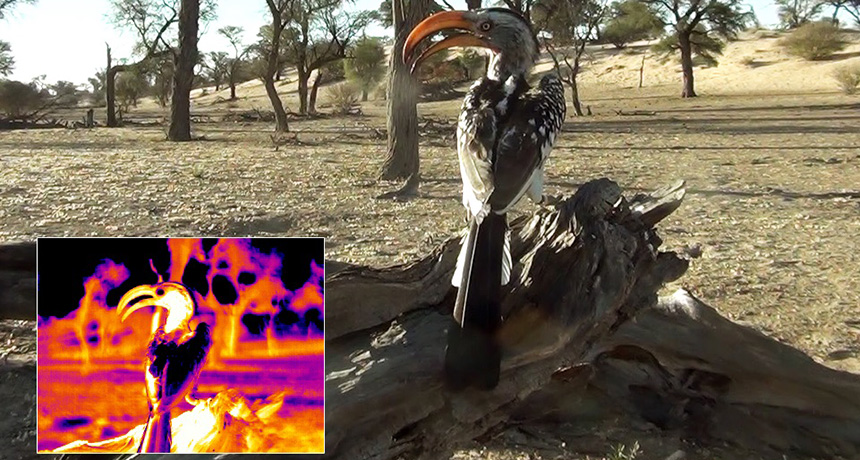
In the scorching heat of the Kalahari Desert, some birds still manage to keep their cool.
Thermal imaging reveals that the southern yellow-billed hornbill (Tockus leucomelas) vents heat from its beak, a phenomenon previously observed in toco toucans (Ramphastos toco). A team of South African researchers snapped infrared photos of 18 hornbills on a farm in the southern edge of the desert at temperatures from 15° to 45° Celsius.
When air temperatures hit 30.7° Celsius, the difference between beak surface temperature and air temperature spikes — indicating the birds were actively radiating heat through their beaks. At most, the birds lost about 25.1 watts per square meter through their beaks. Hornbills probably manage this cool trick by dilating the blood vessels to increase flow in their uninsulated beaks, the team writes May 18 in PLOS ONE.
Toucans lose about 60 percent of their total heat loss through their beaks, but hornbills only shed up to 20 percent of their heat loss through this method. The researchers chalk that difference up to larger beak-to-body-size in toucans.
A last-ditch weapon against drug-resistant bacteria has met its match in Pennsylvania.
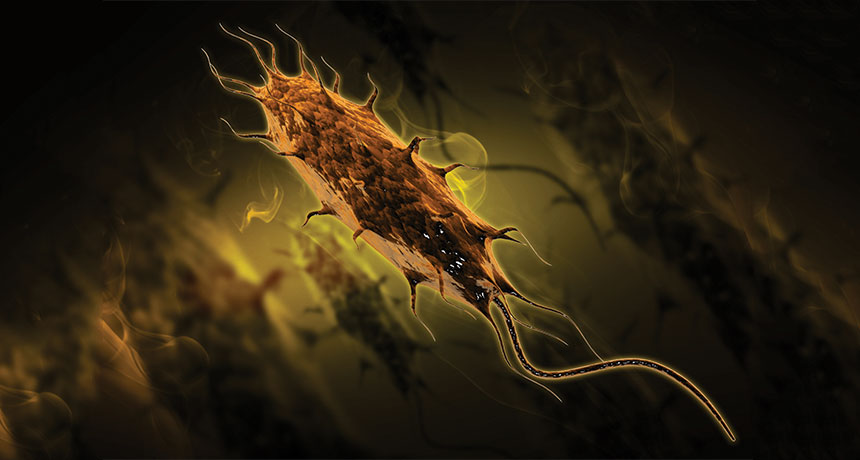
A 49-year-old woman has tested positive for a strain of Escherichia coli resistant to the antibiotic colistin, researchers report May 26 in Antimicrobial Agents and Chemotherapy.
It’s the first time in the United States that scientists have found bacteria carrying a gene for colistin resistance known as mrc-1, write study coauthor Patrick McGann of Walter Reed Army Institute of Research in Silver Spring, Md., and colleagues. But perhaps even more alarming is that the gene rides on a transferable loop of DNA called a plasmid.
“That means we now see a possibility of spread,” says physician and clinical microbiologist Robert Skov. And not just from mother cell to daughter cell, he says, but to neighboring strains of bacteria, too.
Bacteria carry most of their genetic information in a tangle of DNA contained in chromosomes inside the cell. But tiny loops of DNA called plasmids hang around outside of the tangle. These loops carry extra information that bacteria can use, like how to protect themselves from antibiotics. Bacteria can swap plasmids like trading cards, effectively spreading instructions for antibiotic resistance.
In December, Skov and colleagues discovered a Danish patient carrying bacteria with mcr-1 plasmid DNA, like the woman in Pennsylvania. And in November of 2015, researchers reported something similar in China.
Until then, all known colistin resistance was due to tweaks in chromosomal DNA (which, unlike plasmid DNA, isn’t easily spread among bacteria), says Skov, of the Statens Serum Institut in Copenhagen, who was not involved with the new work.
Colistin, a 50-year-old drug that doctors largely stopped prescribing in the 1970s because of its side effects, has made a comeback in the last five to 10 years. It’s used when other antibiotics fail; it’s a treatment option for people infected with multidrug-resistant bacteria. Now, with colistin-resistant bacteria, Skov says, antibiotic treatment options are becoming more and more limited.
The problem, scientists have been pointing out for years, is that people are taking antibiotics too frequently. More use means more opportunity for bacteria to develop resistance.
Still, even with colistin-resistant bacteria emerging all over the world, Skov says he doesn’t expect thousands of people to become infected.
“The scenario now is that once in a while, we’ll see a patient carrying bacteria that we don’t have any good antibiotics left for.” But that, he adds “is dreadful enough.”
Quasisatellite KWAH-zee-SAT-ah-lite n. A body that orbits the sun and appears to orbit Earth.
Asteroid 2016 HO3 appears to orbit Earth, but that’s just an illusion. As the space rock loops around the sun, it plays leapfrog with our planet, sometimes speeding ahead sometimes falling behind. The asteroid’s suncentric orbit keeps it from qualifying as a full-fledged moon of Earth, but its constant proximity to us is enough to make it the only known “quasisatellite” of our world. SUBSCRIBE This temporary tagalong was discovered on April 27 in images from the Pan-STARRS observatory in Hawaii. The asteroid’s orbit around the sun is similar to Earth’s — one year on 2016 HO3 is just about 16 hours longer than an Earth year. Earth’s gravity keeps the asteroid from wandering; it never strays farther than about 400 million kilometers from Earth and never comes closer than about 14 million kilometers (38 times Earth’s distance to the moon).
The tiny rock — no more than about 100 meters across — has probably tagged along with Earth for about a century, and orbital calculations suggest that it will continue to do so for several centuries to come.